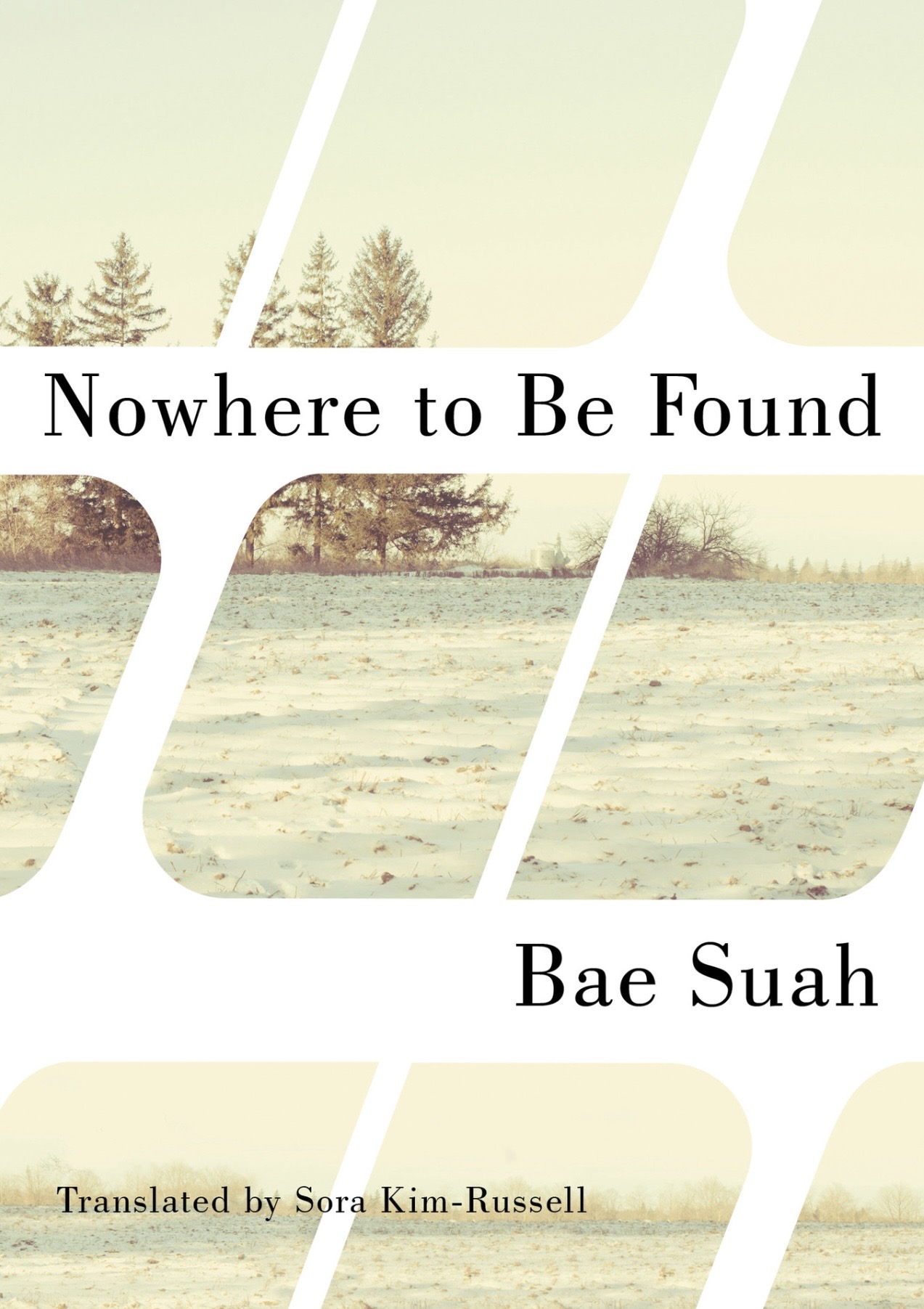
Set in 1988 in South Korea, the unnamed narrator of Bae Suah's Nowhere to Be Found is working a clerical job at a university and waitresses at night. She is the middle child in her distant family with ten years between her older brother and younger sister. Her mother is an alcoholic. Her father is incarcerated for a crime he didn't commit, and she writes him letters she never sends out. Her family's economic situation is so bleak that she shares a winter coat with her sister. Her brother hopes to land a janitorial job in Osaka to support the family.
The narrator has a boyfriend, Cheolsu. They're not exclusively dating, but they act like a couple, and their friends think they're a couple. When they're intimate for the first time, her language is detached and clinical. Cheolsu is also in the military, and one day, his mother wants her to bring him chicken, because she doesn't feel like taking the long commute to the army base.
When she arrives at the base, she's given the runaround and has to go elsewhere to find him. At the bus stop, she notices a wanted flyer for one female and two males for a violent crime. The woman is described as having red hair and wearing baggy pants, and the men were wearing basketball shoes, Remember that.
When the protagonist finally gets to the base and meets up with Cheolsu, she admits she was afraid she would never see him again. At last, she opens up a little and displays some emotion and vulnerability.
After she visits Cheolsu, she becomes sick. Her brother leaves for Japan. Her mother asks how visiting Cheolsu went. She responds with "Cheolsu was not there. Cheolsu fell like a crow from a white cliff while I wandered through a village of soldiers in the snow carrying Cheolsu's dead chicken ..." and her mother notes that she and Cheolsu "don't make sense together."
She's right; they didn't make sense together. But what does make sense in the protagonist's life?
Fast forward, and the narrator is with another lover in a rundown home. She no longer is in touch with her brother, who successfully made it to Japan. She sees herself pass by a window and says, "I've heard that what appears in a hallucination is an image of the dead." Has she become so distant with the people around her that she's distant with herself?
She and her partner go to the Rose Garden. When they get there, she has an encounter with a woman with baggy jeans and dyed red hair and two men wearing basketball shoes. And then, the story ends abruptly. The narrator's take on life and her relationships can be shallow and dislikable, but her raw emotions kept me hooked until the end. I came to care and wonder about her long after I closed the book. She remains nameless throughout the whole novella, which stood out to me, considering how important names and their meanings are in Korean culture, but this further emphasizes the ghostliness of her identity.
I've read 17 books in April and Nowhere to Be Found is my favorite. I was immediately sucked into the narrator's psychology and how she moved through poverty, isolation, and depression. This story can be read in one sitting, but you might find yourself flipping back to earlier passages, searching for fine details you missed. Bae Suah's compact and lyrical prose gave me enough dialogue and descriptions to make the other characters three-dimensional without the need for extended backstories. A beautiful and ugly read that holds more depth and intrigue than most novels five times its length. This is my first read from Bae Suah and it won't be the last.
